

Sole UX/UI Designer of Mobile Application
2020
Porto Alegre, Brazil

DYM is a small, family-owned upholstery and furniture restoration business with nearly 40 years of tradition in Porto Alegre, Brazil
Known for its reliable expertise and high-quality artisanal craftsmanship, the company built its reputation through trust, word of mouth & deeply personal customer relationships
For decades, that approach helped DYM grow without relying on modern digital systems. But the business was facing increasing friction in its daily operations, especially in busy hours, affecting both the customer experience & the small team responsible for delivering it
As the Solo Designer, I was responsible for researching & identifying key opportunities for improvement & focus on problems that were both impactful & realistic to address
in person Research
Before proposing any solution, I spent time observing DYM in person to understand how the business actually worked daily
I visited the small store repeatedly, paying attention to its workflows, customer service interactions & the routines that kept the operation moving
From the first visits, their greatest strength was clear:
a warm, welcoming shop where the owner couple & their team treated customers with patience & familiarity from the moment they walked in

analog-based
During this all this years, relying on word of mouth, repeat customers & consistently high-quality work. DYM have not modernized their operations & remained largely analog
Everything was documented in hundreds of notebooks. From sales to inventory purchases, payments, expenses & receipts
The small yellow pages inside light-blue covers had become, the company’s entire operating system, making information difficult to track, access & coordinate quickly
*I could identify that service decisions & quote preparations depended heavily on the owners’ experience, memory & manual interpretation of each request
To better understand the experience & discover opportunities
I mapped out the current Customer Journey across the three main channels

With the Customer Journey diagram
I could identify, across the service channels, the following Consistent Steps:
Understand
Define
DECISION POINT
Execute
*Mapping the Customer Journey, helped me identify where friction happens across the journey & where a design opportunity might exist


Rather than following a rigid script for the interview, I preferred a real-life conversation
So the owner could to share insights about his clients & the business in his own words
customer loyalty
Most customers are long-term clients, often referred through word-of-mouth. Many return repeatedly & the DYM has worked across generations within the same family
For these clients, restoration was not just a transactional decision
They relied on DYM because they trusted the consistency of the materials, the quality of execution, and the transparency of the process. In an industry where shortcuts & lower-quality practices are common
technology
The owner is open to technology but values simplicity
Any solution would need to reduce effort, not introduce a new layer of confusion for a small team already struggling
This immediately shaped the direction of the project:
Learning a new tool would only create more friction Improvement meant facilitating how they already worked
the owner’s expertise
The interview also revealed that quoting was not a simple price lookup
The owner’s experience played a central role in interpreting each service request & understanding how different variables affected the final cost
Furniture type, size, quantity, structural condition, special mechanisms, fabric choice & labor influence the cost
Over time, he had developed a manual calculation method for weighing these variables "quickly" & responsibly
WhatsApp played a central role in their customer interactions
It was where many customers asked questions, shared photos of their furniture, discussed timelines & continued conversations after an initial contact
Photos were especially valuable. They helped the owner identify the furniture type & visualize the condition of the piece
WhatsApp also kept conversation history in one place, making follow-ups easier
I understood it as an essential tool for the business
Familiar to customers, practical for staff & essential for their communication
*In Brazil more than 96% of the Brazilian population uses the messenger app almost every day
Source: Statista
cost & quoting
The owner also explained that pricing varied greatly depending on the complexity of each piece
Fabric choice, structural issues, reclining systems, loose or fixed cushions, & rocking mechanisms were some of the common details that affected cost because they required specialized labor
As a result, each estimate needed enough detail to prepare an accurate "Detailed Quote"
daily on-site observation
informal conversations
paper notebook
Using behavior & motivations inputs, I created three personas to guide the design empathy & "visually" represent DYM's current customers
This ensures that every UX decision, tone, interface complexity & flow, was designed for real-world client needs



Although the personas differed in age, motivations & comfort with technology, they shared Common Needs like:
a process that feels clear, personal & trustworthy from the beginning
a quick estimate that helps decide whether restoration service is worth the time, money & effort
transparent info about cost, timeline & materials
The goal of this market research is to better understand the present & future trends of the areas of furniture, upholstery & furniture restoration
Also, to gain a deeper understanding of potential customers, their motivations, values & lifestyles.
sources & methods
To gather meaningful insights, I reviewed a variety of trusted sources. This included consumer trend reports & industry analyses that explored topics such as sustainability, circular economy practices & the behavior of younger consumer groups like Gen Z & Millennials
rising consumer trends
Across digital trend platforms such as TrendWatching, Pinterest Predicts & Google Trends, a clear pattern emerged:
More consumers were beginning to value products not only for price or aesthetics, but also for durability, ethical meaning & the story behind them
Socially Responsible Consumption
Consumers, particularly Millennials & Gen Z, were showing greater concern for where & how products are made, what materials are used & how waste can be reduced. Purchasing decisions were becoming more closely tied to values, not just convenience. The ethics behind consumption now play a direct role in purchasing decisions. This shift is driving demand for sustainable, socially responsible goods & services

The “Reduce, Reuse, Recycle” Economy
The second-hand and refurbished goods economy has expanded significantly. The fashion industry, for example, has seen a surge in resale platforms like Poshmark, Grailed & Vestiaire Collective, alongside the continued growth of thrift stores & DIY trends. This attitude is spreading into other markets, including home furniture, where consumers seek refurbished or upcycled alternatives over new items, valuing their environmental impact as well as their uniqueness

A Return to Craft & Vintage Quality
There is increasing cultural appreciation for vintage pieces, especially furniture designed in previous decades. These items are seen not only as sustainable choices but also as design statements. Consumers are learning to value quality and craftsmanship. Restoration offered a way to extend the life of meaningful pieces while avoiding lower-quality, mass-produced alternatives

why this matter?
These reinforced an important strategic opportunity. This is not a declining craft niche, but a service category becoming increasingly relevant to a new generation of customers
DYM already has the values these consumers were beginning to seek, craftsmanship, durability, authenticity & respect for existing objects
What is missing is a more accessible digital entry point that clearly communicates those values & easily helps new customers take the first step with confidence
There is growing group values more than aesthetics,
they value sustainability, authenticity & purpose
Ethically curating meaning
&
Investing in long-term value

Unlike DYM loyal long-time customers, they do not know the business personally or arrive through referrals
Their trust needs to be earned
A clear, transparent digital experience can make the service feel approachable & easy to engage with
designing for both customers
If the app is too traditional, too vague, or too dependent on prior trust will struggle to engage newer customers
If is too polished, complex, or impersonal, will risk losing the warmth & simplicity valued by loyal customers
This created an important Design Direction:
The experience needs to be
simple & human to Current Customer
while being
clear & quick for the Potential Customer
the real problem was not the Analog system
At first glance, because DYM relied on notebooks, manual processes, phone calls & WhatsApp conversations to keep daily operations
The biggest challenge seemed to be the lack of modern systems
But after spending time inside the store, observing the team, listening to customers, Interviewing the owner, mapping the current Customer Journey & studying both Current & Potential Customers,
I realized that a full modernization would be too risky for a small business, because implementing at once would be really complex & time consuming
the issue is more specific
Taking more time to analyze & find friction points that could become design opportunities,
I wrote down truths about DYM & filtered them on "possible" frictions points:

the team is small & constantly multitasking
→
hard to respond quickly to new requests
busy moments create pressure
→
small delays can turn into longer response times
every customer interactions required a manual response
→
basic questions often take extra time to clarify
fully depended on the owners intake & calculations
→
bottleneck in the estimate process
the owner’s experience shaped every estimate
→
difficult to scale without
many requests started with curiosity, not commitment
→
staff effort was spent before knowing if the customer would move forward
customers want quickly & reliable information
→
decide if service is worth pursuing
the business is successful because of their overall quality, trust & personal communication
→
so the process cannot feel cold or automated
a useful quote needs context
→
photos & basic information are not always enough
not every item follows the same logic
→
different furniture needs different questions
some details are invisible at first
→
the quote cannot be treated as a fixed number too early
small-team
owner dependency
customer uncertainty
quote complexity
DYM has a small-team handling many roles at the same time. The same people were welcoming customers, answering calls, managing WhatsApp messages, preparing work, checking details & keeping daily operations moving
The business also had strong owner dependency. The owner’s experience was central to the way estimates were understood & calculated. His knowledge made the service trustworthy, but it everything still depended on his judgment
At the same time, customers came with uncertainty. Many were not ready to commit immediately. They wanted to understand whether restoration was worth pursuing, how much it might cost & whether the value made sense compared to buying something new
Finally, the service itself had quote complexity. A price could not be defined from one simple question. Furniture type, condition, size, fabric, features & labor could all affect the final value
I realized that
the quote process
It's the moment where all friction points come together
This makes the quote process the "clearest" Design Opportunity
improving it could reduce customer uncertainty & repeated effort for the team at the same time
the highest-friction moment in the service journey
When I returned to the Customer Journey diagram with this reframed problem in mind, one pattern became impossible to ignore: the quote process appeared across every major service channel
Whether customers contacted DYM in person, by phone, or through WhatsApp, they eventually had to go through the quote process which include the following steps:

"Start Quote Process" - the starting point
"Own Fabric?" - does the customer already have chosen its own fabric, so it is only interested in the service?
"Yes" or "Check Fabric Samples" - depending on answer fabric samples are showcased separated by company, varying price & style
"Average Estimate" - a superficial estimate is given to the customer, based on the basic information got before the "Start Quote Process" & the fabric choice
"Customer Decision" - based on the previous step information the customer needs to make a decision about moving forward or not
"Think About it" - customer will "Receive a copy of Estimate"
or
"More Details" - moment where other important details that affected might cost are investigated through photos or by asking the customer directly depending on type of furniture. These details may include structural issues, reclining systems, loose or fixed cushions & rocking mechanism, analyzed exclusively by the owner
"Detailed Quote" - using the "Average Estimate" as foundation, any added costs from "More Details" are recalculated & exclusively by the owner & the final cost is provided to the customer. This is followed by the "Final Customer Decision" & possible payment & pick up information
What is the quote process represent for each group:
for customers
The quote is often an early decision-making tool
Customers are often still exploring whether restoration is worth it compared to replacing the furniture
Before committing, they wanted quick clarity around costs, timeline & process
for the owner
A quote depended heavily on his experience
Years of practical knowledge helped the owner interpret photos, identify hidden variables & judge realistic repair effort
Because of this, every quote still required direct owner attention & manual calculation
for DYM
A quote is not just a number
It requires context: the type of furniture, its condition, dimensions, materials, structural details & possible mechanisms
These details directly affect price, time & labor

Truths about the quote process:
recurring
It appeared across every major "Customer Journey", making it a strong opportunity for scalable improvement
manual
Each quote required customer communication, visual assessment, calculation & owner review
creating an operational burden for the small team
early-stage
Many customers requested a quote before they were fully committed, so the experience had to support exploration as well as decision-making
decisive
The quote shaped how customers judged transparency, professionalism, quality & value
A slow or unclear quote could reduce trust before the craftsmanship had a chance to speak for itself
lack of efficiency
Each quote could require back-&-forth clarification & owners' manual interpretation of each request — even when the customer was still only researching & might never convert into a sale
For a small team, this make the quotation process consuming & difficult to scale
After identifying the quote stage as the highest-friction moment
I re-checked the original Customer Journey to understand not only where friction happened, but why it happened
In the existing Customer Journey:
Customers could receive an "Average Estimate" then had to make a early-stage decision-making before DYM even collected important details that directly affect the service
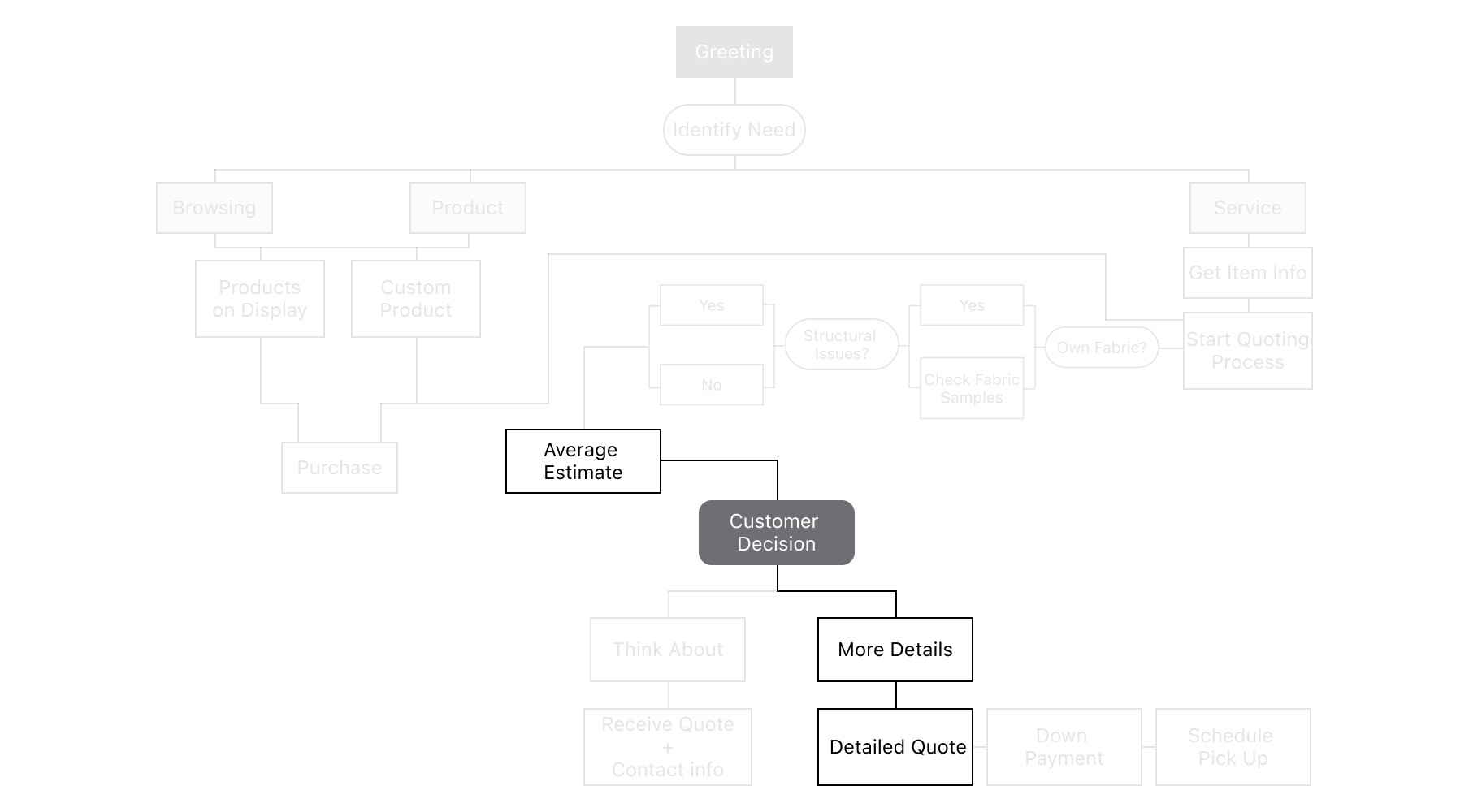
This created a weak decision point for the customer
Important information such as the type of furniture, its condition, dimensions, materials, structural details & possible mechanisms appeared later during the “More Details” step only before preparing the "Detailed Quote"
Customers were asked to decide whether to continue based on an vague estimate
while
DYM still needed additional information to understand the real scope of the work & inform the "Detailed Quote"
The result was extra back-&-forth, repeated clarification, manual calculation & owner involvement before the team could provide a more useful answer, for a process that even might not convert into a sale
Something definitely needed to change
what if
We removed the early weak decision point created by the "Average Estimate"?
The journey helped customers make a stronger, more informed decision?
Instead of the important "More Details" information asked after Customer Decision are asked before?
DYM could avoid manual calculation & owner involvement before knowing whether the customer has potential?
Customers only received a quote after DYM had enough information to establish the real scope of work?
The "Detailed Quote" became the main "Customer Decision" trigger instead of the "Average Estimate"?
These questions helped me explore possible changes to the Customer Journey
After several iterations, rounds of questioning & time spent refining the process, I finally identified a possible “right” order for the journey
This shifted the journey from
Average
Estimate
CUSTOMER DECISION
More
Details
Detailed
Quote
More
Details
Detailed
Quote
CUSTOMER DECISION
→
Average
Estimate
This shifted the Customer Journey from customers deciding after a vague estimate to customers deciding after important details & a complete detailed quote
The right information will be collected reducing unnecessary back-&-forth & helping customers decide & move foward with more clarity & confidence
After redesigning the sequence of the Customer Journey, the next step was to translate that shift into a Design Challenge
The core challenge is:
Customers need enough clarity to make a confident decision, while DYM needs the right information early enough to avoid back-&-forth
Instead of jumping straight into solutions, I reframed these pain points into How Might We questions
These questions helped turn the problems into design opportunities
How Might We help customers make a more informed decision
while helping DYM collect the right quote information with less repeated effort?
This became the guiding design challenge
From there, I broke it down into four smaller questions that shaped the concept
How Might We collect important details without overwhelming the user?
In the original journey, important details were often collected later during the "More Details" step
The challenge is to collect this information through a flow that felt simple, calm & like a real-life conversation — especially for customers with lower digital comfort
How Might We make the initial estimate more useful?
Customers were often deciding whether restoration was worth it compared with buying new furniture
they needed clarity around price, value & next steps before deciding whether restoration was worth pursuing
The experience needed to help customers reach the "Customer Decision" step with better information, not just a rough number
How Might We preserve the human relationship?
WhatsApp was already central to DYM’s customer communication. Customers used it naturally & DYM relied on photos and message history to understand each project
The product should not replace that relationship. It should prepare the conversation better, so the human follow-up could be faster, clearer & more useful
How Might We reduce repeated effort for the team?
Because DYM operated with a very small team, every repeated question, incomplete message, or missing detail created more back-&-forth
The product need to structure the intake process so customers could provide better information earlier, helping the team avoid unnecessary back-&-forth before continuing the conversation
These questions helped shape the direction of the solution
help customers reach a useful "Detailed Quote" quickly
collect "More Details" information earlier
reduce repeated effort for DYM’s team
preserve WhatsApp confirmation as the final human step
The strategy is to redesign the quote process around the same shift identified in the Customer Journey Redesign: moving important details before the “Customer Decision”
The goal is not simply to digitize DYM’s existing quote process
I wanted to rethink the order, structure & clarity of the experience
The design strategy was built around five moves:
repositioning by priority
In the original Customer Journey, important details that influenced directly the final price appeared later in the process, after customers had already received an average estimate or reached a decision point
The strategy is to reposition these important details from “More Details” step, earlier in the experience, before the "Detailed Quote" & before the "Customer Decision"
This would make the decision moment more informed
real-life conversation
The quote process requires multiple pieces of information, but asking everything at once could feel overwhelming intimidating & create even more friction for users
especially because DYM has customers with different levels of digital comfort
The strategy is to make the experience feel closer to a real-life conversation, guiding them step by step
custom path
Not every restoration request needs the same information. A couch, a chair, an armchair, or another furniture type can involve different cost variables
The strategy was to adapt the path based on the selected furniture type
This keeps the experience focused. Customers are not asked unnecessary questions & the necessary information is gathered
use calculation as guidance
Quotes depended on the owner’s experience, manual judgment & cost variables such as size, quantity, condition, features, fabric & labor
Instead of presenting only a "Average Estimate", the app uses these variables to generate a "Detailed Quote" that reflects the real pricing logic behind upholstery & restoration work
The strategy is to translate the owner’s quote logic into structured coding lines so it can automatically calculate the key cost variables & provide the customer directly with "Detailed Quote"
keep WhatsApp
WhatsApp was already central to DYM’s service experience
Customers used it naturally & the owner relied on photos, message history, and direct conversation to understand each project
The strategy is not to replace WhatsApp with a new communication system
After defining the strategy,
it was even more clear the desire of creating an mobile application that would support the "Customer Journey"
I translated each strategic move into concrete product decisions:
repositioning by priority
The strategy is to reposition important details from “More Details” to earlier in the experience.
Before the "Detailed Quote" & the "Customer Decision"
→
flow integration
Repositioning & integrating the important cost-related questions into the main flow will be effiicient
The customer will have a more informed quote & a clear vision of the process & DYM that will receive a better information from the beggining
This decision combines two previously separate steps into one smoother experience
real-life conversation
The strategy is to make the experience feel closer to a real-life conversation, guiding the customer step by step
→
one-question-at-a-time
Based on the current & potential personas & their different levels of digital comfort, I wanted to create a flow that would not feel overwhelming or overly complex
From the first screen to the last, the next step should always be obvious, making the experience simple to navigate. Each screen focuses on a single input, or a maximum of two decisions, which creates a calmer rhythm, reduces cognitive load & makes the process feel closer to a natural question-and-answer conversation
The goal was to guide customers step by step toward a clear answer, with fewer bottlenecks and fewer moments of uncertainty, such as “Where should I click now?” while using the app
custom path
The strategy was to adapt the path based on the selected furniture type
→
create branching questions based on the selected item
Early on the journey, would be essencial to create opportunity for the user to select the furniture type
Based on the variables, this step determines which questions will appear next in the flow, making sure the experience is relevant
guided calculation
The strategy is to translate the owner’s quote logic into structured coding lines so it can automatically calculate the key cost variables & provide the customer directly with "Detailed Quote"
→
guided calculation
The app will follow the appropriate coding logic & calculation path, so customers are not asked unnecessary questions
By translating the owner’s manual quote into the app, automatically process the cost variables & generate a more informed "Detailed Quote"
However, this quote remains flexible. The value may still change depending on fabric choice, furniture condition, or details that were not provided by the customer or not visible through the flow
So, the app must communicates that this quote, is as the closest possible quote based on the information provided
keep WhatsApp
The strategy is not to replace WhatsApp with a new communication system
→
End the session with contact, not checkout
The app does not try to complete the entire service digitally
After receiving the "final quote", the customer is guided to the familiar WhatsApp
The customer arrives with:
a clearer sense of price,
relevant project details already collected,
better understanding of the next step
DYM receives a more organized starting point instead of a vague message
The app becomes the structured beginning of the quote process, not a replacement for the relationship
additional product decision: avoid a digital Fabric Picker
During ideation, I explored the possibility of adding a digital Fabric Picker
The Fabric question is the first one on the quote process & would be easily solved by adding an sort of digital fabric catalog
also with this information the quote would be the closest to the final quote as possible (having only change margin for information not given by the customer or not visible)
However, when compared against the strategy, the feature created problems
A digital fabric catalog could make the experience feel more complete, but it could also create false expectations. Fabric colors and textures are difficult to represent accurately on a screen, because it would depend much more on the customers' devices then anything else
Also, prices vary widely between basic fabrics, imported materials, leather & premium options. DYM does not rely on a fixed fabric inventory & some customers prefer to bring their own fabric
Because of this, a Fabric Picker would not make the estimate feel more precise & would potentially create a friction point
Instead, I kept the app focused on generating a calculated estimate
This decision supported the main strategy: provide clarity without overwhelming the user or creating false certainty
Each product decision supported the same goal:
Help customers reach a more informed decision while helping DYM collect right quote information with less repeated effort
This is the updaated "Customer Journey":

After redefining the Customer Journey, the next step is to translate that strategic structure into a usable app flow
fast
frictionless experience
that mirrors the simplicity of a real-life conversation
saving time for both the customer & the staff

welcome & basic information
The experience begins with a simple welcome & name input
This creates a more personal tone from the start, inspired by DYM warm welcoming, but remaining direct, simple, & human
furniture type
Instead of every customer goes through the same quote process, the app identifies the type of furniture the customer wants to restore
By identifying the item early, the app avoids asking unnecessary questions
guided questions
After the furniture type is selected, the app asks only the questions that matter for that item
sofas may require size-related questions
chairs may require quantity
armchairs may require feature questions such as whether the piece reclines, swivels or includes loose cushions
other furniture types may follow a more general information path
These questions reflect the kind of details DYM already considers during the manual quotation process. The difference is that the app collects them earlier, in a more structured way
quote finished
Once the guided intake is completed, the app generates the Quote
The quote gives customers a clearer sense of value before they decide whether to move forward
It also helps DYM receive better-structured information
WhatsApp confirmation
At the final step, instead of building a new communication system, the app launches a pre-filled WhatsApp message containing all the provided data
This leverages a tool customers are familiar
Benefits that DYM already has with WhatsApp (interface familiarity, conversational history & data continuity)
Also allowing DYM to collect direct contact information for each customer & more easily personalize their experience, both from a technical standpoint & through more personal interactions
The wireframe was the first step in visually organizing the ideas gathered during the research phase & implement into a simple UI
To better vizualize the UI screens I needed to design
I divided the User Flow into steps, knowing that possible a few variations of screen would have in each step, but that helped to start the low-fidelity wireframes
Welcome
Basic
Information
Furniture
Type
Guided
Questions
Quote
Screen
This helped me to:
organize the flow
prioritize content
quickly explore ideas
identify usability issues

The flow starts with the user opening the app, friendly asking for the user’s name & immediately selecting the type of furniture they want to restore
the app guides the user through a series of short, single-purpose screens. Each question is phrased in the same tone & vocabulary observed during in-store visits
making it intuitive even for less tech-savvy customers, reducing moments of uncertainty
In the final screen, because fabric, condition, and other details may still affect the final value, the quote screen includes a clear message explaining that the value may varyhis keeps the experience useful, transparent, and honest
Simple
Easy to navigate & straightforward to use
Human
Feels personal, not automated or cold self-service

Although the DYM mobile app was not launched as a fully developed MVP, the project successfully achieved its original goal: to identify how a small, tradition-based upholstery business could modernize its customer experience without sacrificing its values.
Through deep field research, stakeholder interviews, and human-centered design, the project revealed key insights about DYM’s workflows, client behaviors & service bottlenecks.
The most impactful outcome was not technological, it was strategic. The UX design process helped DYM formalize & improve their use of WhatsApp as a service channel, implementing structured quote flows, reusable messages & visual intake methods that saved hours of back-and-forth per week.
One of the greatest lessons was that small & detailed/practical interventions can be transformative especially in limited (financially/time/team wise) projects.
Next time, I would explore opportunities for low-prototyping & real-time usability testing with current customers to validate assumptions even faster.
This project reinforced my belief that UX design isn’t about perfection—it’s about clarity, empathy & adaptability.
Even as a conceptual product, the DYM app served as a bridge between tradition and transformation, creating value beyond the screen.